Topoisomerase DNA cleavage assay
(for topoisomerase inhibition mechanism and drug toxicity tests)


Bacterial gyrase, topoisomerase IV (parC-parE ) and mammalian topoisomerase II are type II topoisomerases. These topoisomerases change DNA topology by cleavage and religation of both DNA strands. When an inhibitor such as fluoroquinolone drugs blocks the religation step of the topoisomerase reaction, the cleaved or linearized DNA forms covalent complexes with the enzyme (cleavage complex). Formation of DNA cleavage complexes causes DNA damage in the cells (topoisomerase poison). Testing formation of DNA cleavage complexes is useful for understanding the topoisomerase inhibition mechanism of novel topoisomerase inhibitors. It is also useful for toxicity evaluation regarding to human topoisomerase II.

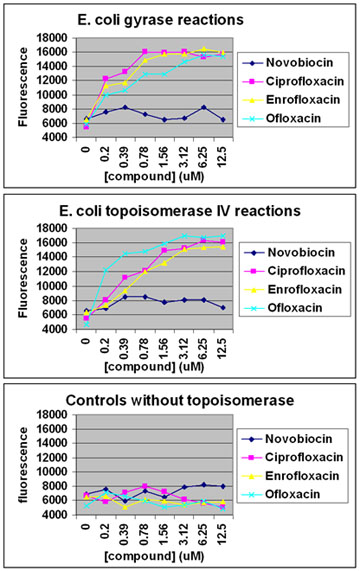
ProFoldin’s topoisomerase DNA cleavage assay kit is based on the principle that the linearized or cleaved DNA has much greater permeability through a solution matrix and a filter than the closed circular DNA. For example, both novobiocin and ciprofloxacin inhibit DNA gyrase. However, novobiocin does not cause formation of cleavage complex. Ciprofloxacin does.   The assay kit (TDC96K) is in 96-well plate format and suitable for testing one or many compounds at a time. The kit includes the reaction buffer, DNA substrate, protease digestion solutions, solution matrix, rinse buffer, DNA detection dye and a filter plate. Topoisomerase is not included in the kit but can be purchased separately. A plate filtration device (see Note bellow) and a vacuum line are needed for the plate filtration process.
Storage: Do not freeze the TDC matrix. Store the kit at 4ºC.
 

Note: Recommended filtration device: Multi-well plate vacuum manifold, Pall Corporation, catalog No. 5017.  



Powered by CityMaker.com